
Cabochon, Faceted or Rose Cut: Which Stone Cut Sells
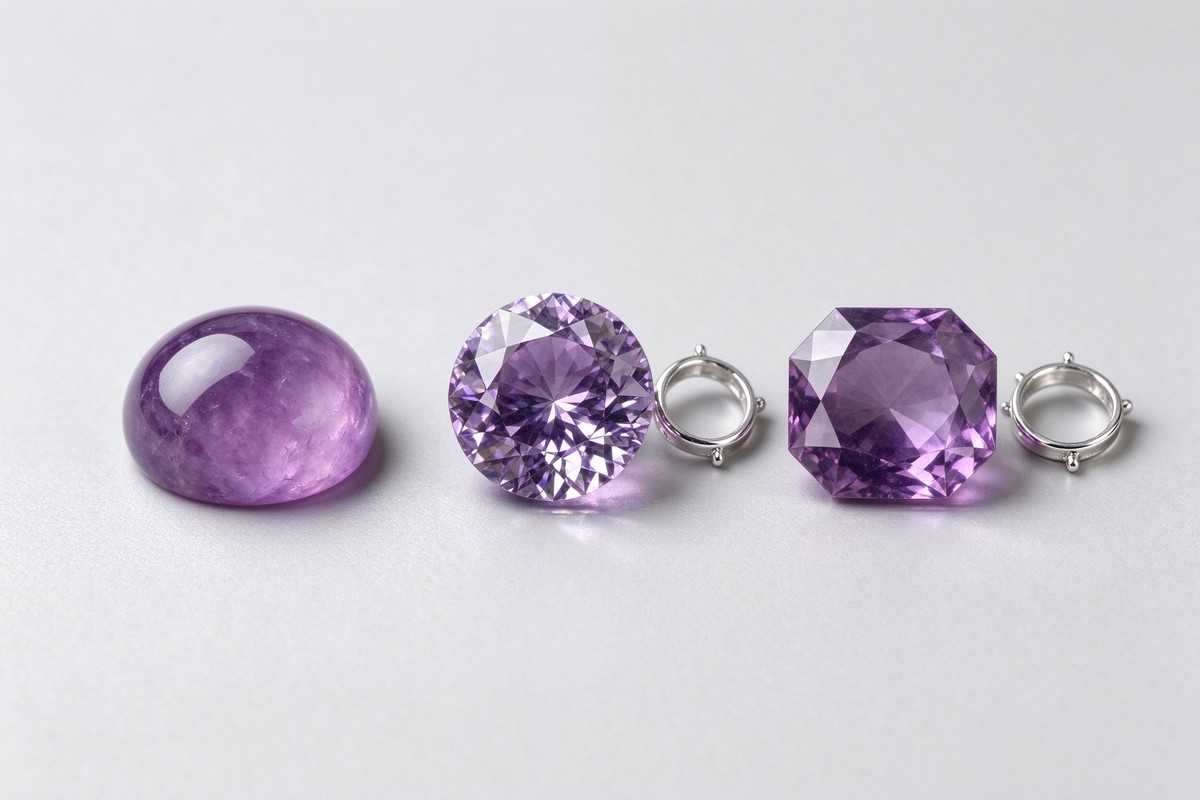
Same stone, three cuts. The cut decides how it reads on the shelf, how much material is lost, and which setting can hold it.
Buyers usually choose a stone by color and size, then treat the cut as a detail. It is the other way around: the cut is what a customer actually sees first, and it determines both the price you can charge and the setting you can use.
Three cuts cover almost everything in a wholesale line — cabochon, faceted and rose cut. Each has a different job, a different cost structure and a different set of stones it flatters.
1. What each cut actually looks like
Cabochon is a smooth domed top with no facets. It does not throw sparks; it glows. The stone's body color, internal bands and any natural inclusions are the whole show, which is why it suits moonstone, turquoise, agate, jade-like material and anything with a pattern worth showing.
Faceted is the classic brilliant-style cut with a table, crown and pavilion. It depends on transparency and cleanliness: light enters, bounces, and comes back as brightness and fire. Amethyst, citrine, garnet and topaz all read better faceted than domed.
Rose cut is flat-bottomed with a low, broad crown of triangular and kite-shaped facets. It is quiet rather than sparkly, sits low on the finger or lobe, and carries a vintage read. Because it needs less depth, it can use flatter rough that a full brilliant cut would reject.
The practical test is simple: hold the stone at arm's length under shop light. If the color still reads, it can be a cabochon. If it goes flat and gray, it needs facets to stay alive.
2. How the cut moves your unit cost
The cut changes how much of the rough survives. A cabochon only needs a slice and a domed top, so the yield is high and the cutting time is short. A faceted stone needs a symmetrical girdle, a correct table angle and a clean pavilion, so more material is lost and more skill goes in. A rose cut sits in between: shallow, but still requires an even crown and a flat bottom.
This is why two stones of the same color, size and clarity can land at very different prices. The faceted one is not "better" — it consumed more rough and more labor. If your price point is tight, a cabochon in the same color is often the smarter buy, and it will look intentional rather than cheap if the design supports it.
One caution on mixed lots: cabochon and faceted stones of the same nominal size do not look the same size. A domed 8 mm reads larger and softer than a faceted 8 mm, which reads tighter and brighter. Match by visual footprint, not by millimeter number, when both cuts appear in one collection.
3. The setting has to match the cut
A bezel around a faceted stone kills its light. Prongs on a flat rose cut leave the girdle exposed and the stone sits too high. Most "the stone looks dull" complaints are a setting mismatch, not a stone problem.
For cabochons, a bezel is the safest choice: it hides the girdle, frames the color and protects a softer stone. Four prongs work if the dome is high enough; pavé or bead setting suits small cabochons in a cluster.
For faceted stones, four or six prongs let light enter from the side. A thin bezel can work on a large stone if the design calls for a cleaner frame, but keep the bezel low so it does not shade the crown.
For rose cuts, use a low bezel or a channel. The stone is shallow, so a tall prong setting makes it look like it is floating above the metal. A closed back with a low wall is the usual answer, and it also protects the flat underside.
| Cut | How it reads | Yield and cost | Best setting |
|---|---|---|---|
| Cabochon | Soft glow, body color | High yield, lower unit cost | Bezel, four prongs |
| Faceted | Bright, high contrast | More loss, higher cost | Four or six prongs |
| Rose cut | Quiet, vintage | Mid yield, flat rough | Low bezel, channel |
4. Silver and copper lines need different cuts
On a sterling silver line, the stone is usually the reason the piece exists, so let the cut carry the value. Transparent semi-precious stones — amethyst, citrine, garnet, blue topaz — sell on brightness, so facet them. Opaque or patterned stones — turquoise, moonstone, agate — sell on surface, so keep them domed.
On a copper line, the piece usually has to hit a retail price that leaves little room for stone cost. Large cabochons and carved or tumbled surfaces give more visual presence per dollar than a brilliant cut, which is why they dominate gift and fast-fashion assortments. Faceted crystal still works, but keep it small and use it as an accent rather than the centerpiece.
Do not mix a cabochon and a faceted stone of the same color inside one design unless the contrast is the point. Half-domed, half-brilliant in the same ring reads as a sourcing accident, not a design decision.
5. A first assortment that tests the cut, not just the color
Most first orders test too many colors and too few cuts. Pick two colors you can defend, then give each color two cuts and three sizes — for example a faceted 6 mm, a faceted 8 mm and a cabochon 8 mm. That is six SKUs per color and it answers the real question: does this customer buy brightness or body color?
Keep one rose cut in the mix only if the design language supports vintage. It is a slower seller in most contemporary lines, but it photographs well and gives a collection a piece that looks different from everything else on the page.
Three checks before you approve a cut
1. Table-to-pavilion proportion: a faceted stone with a shallow pavilion goes dark in low light.
2. Girdle symmetry: an uneven girdle makes the stone sit crooked in any setting.
3. Bottom thickness on a rose cut: too thin and it cracks under a bezel; too thick and it sits high.
We run our own production workshop in Meilong, China. For export orders, we settle through our licensed trade entity — so you work directly with the makers, without a middleman in between. Stone lots are reserved at order confirmation, and the cut is fixed with the setting before the mold is cut, so the two do not have to be reconciled later.
Sterling silver lines start at 20 pieces per design with 12–15 days for bulk; copper starts at 100 pieces and is typically completed within 7 days. Samples run 4–7 days at about three pieces per design.
Send the stone and the setting you have in mind — we will tell you which cut fits.
Reference photos are enough to start. Design details stay confidential.
Send Your Inquiry