
Why Your Sample Looks Better Than Bulk: 5 Places Quality Drifts
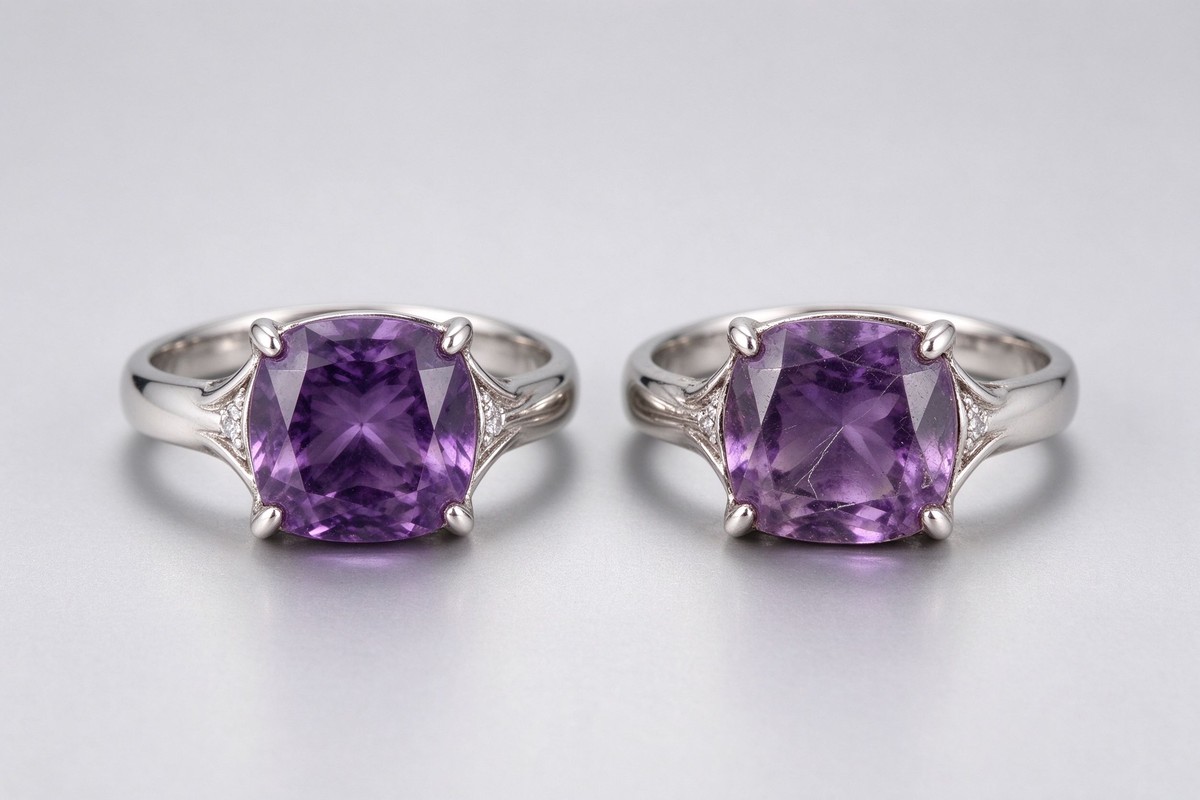
Same design, two outcomes. The difference between a sample and a bulk batch is usually measured in tenths of a millimeter.
Your sample was made as a single piece, by one setter, with time to redo anything that looked wrong. Bulk is made as a batch, across stations, against a schedule. The gap between the two is rarely a "bad factory" problem. It is five specific places where quality drifts, and every one of them can be locked down before you sign the PO.
Here is where the drift happens, what it looks like on the table, and what to write into the order so it does not happen to you.
1. Stone batches are not the same batch
A color code on a stone chart is a range, not a single value. Amethyst marked "medium purple" can arrive in three different tones across three lots, and the lot that made your sample is often not the lot that makes your bulk.
On a single sample the difference is invisible, because there is nothing to compare it to. On a 200-piece run, one tray of stones that reads cooler than the rest becomes a visible band in the finished order.
How to lock it: keep the sample stones, record the lot number, and ask that the bulk run be cut from one reserved lot. If the lot cannot cover the full quantity, split the order into two clearly labeled color groups instead of mixing them across the run.
2. Casting and filing tolerances
A sample passes through filing and pre-polishing as one piece, often with a second pass on the edges. In bulk, filing is a station: each piece gets a fixed cycle time, and the operator's job is to keep the line moving.
The result is not scrap. It is a slightly softer edge, a slightly less even inner wall, a sprue mark that was chased a little less aggressively. Each piece passes; the batch looks marginally less crisp than the sample.
How to lock it: define which surfaces are "critical appearance surfaces" in the PO — usually the front face, the outer edge and the area beside the stone. Ask for those three zones to be hand-finished, and accept normal variation on the inner wall.
3. Prong count, prong angle and the final squeeze
This is the most common place a customer says "the bulk feels different." The prongs are there, the stone is secure, but the setting reads flatter than the sample.
Two causes: prongs finished by different hands at different stations, and a final squeeze that is tighter on some pieces than others. Over-tightening compresses the stone and flattens the light return; under-tightening leaves a prong that looks loose even when it holds.
How to lock it: photograph the sample setting from three angles — straight on, 45 degrees, and from the side — and attach those images to the PO as the acceptance reference. Ask for the same setter or the same station to handle the full run where volume allows.
4. Plating thickness and rack position
Plating is where a batch can look perfectly uniform in the tray and fail in the field. Current density is not identical across a rack: pieces at the contact points and pieces at the edges of the rack can end up with thinner coverage than the sample, which was plated alone.
Rhodium over white metal hides this well for the first weeks. Gold over copper does not: thin edges age first, and the failure shows up as a ring of warmer color around the profile.
How to lock it: specify a minimum thickness rather than a "standard plating," ask that the full order be plated in the same bath and the same rack run, and request a thickness record or a wear test result with the shipment.
5. Polishing method and post-treatment
A sample is usually hand-polished to a mirror on the high points. Bulk often finishes in a barrel or a mass-finishing line, which is efficient and consistent but softer: fine texture can be smoothed away, and a mirror surface can read slightly hazy under retail lighting.
This is not a defect. It is a different finish, and it is the one most likely to be noticed by a buyer comparing the bulk to the sample on their own desk.
How to lock it: name the finish in the PO — mirror, satin or brushed — and state whether hand-polishing is required on the critical surfaces. If the sample was hand-polished, say so explicitly; "same as sample" is not a specification.
| Drift point | What the sample shows | What bulk does |
|---|---|---|
| Stone batch | One tone, hand-picked | Tone shifts between lots |
| Filing | Second pass on edges | Fixed cycle per piece |
| Setting | One setter, balanced squeeze | Multiple hands, uneven squeeze |
| Plating | Plated alone, full coverage | Rack position affects thickness |
| Polish | Hand-polished high points | Mass finish, softer gloss |
The three things that prevent most disputes
1. Keep three pieces from the approved sample lot, sealed and dated.
2. Photograph twelve views: front, side, inner wall, prong detail, stone face, plating edge, at fixed light.
3. Attach those photos and the tolerance notes to the PO. A sample in a drawer is not a standard; a signed reference is.
How to inspect the batch against the sample
Pull a sample across the run, not from the top of the first carton. A practical rule for a first order: ten percent of each SKU, never fewer than five pieces, taken from at least two production days if the run spans more than one.
Check the same five points in the same order every time: stone tone under a neutral lamp, edge crispness on the critical surfaces, prong symmetry at 45 degrees, plating color at the profile edge, and gloss on the high points. Score each piece pass or fail against the sealed sample. Do not negotiate a piece that fails two points — replace it.
Ask for photo or video records before the cartons are sealed. A short clip of the actual packed batch, shot under consistent light, catches most of what a final inspection would catch later — and it is far cheaper than a return.
What we control on our side
We run our own production workshop in Meilong, China. For export orders, we settle through our licensed trade entity — so you work directly with the makers, without a middleman in between.
That matters here because the five drift points above are station-level problems, not trading-desk problems. The person who can change the filing cycle, the setter assignment or the plating rack is the same person you are talking to, which is why a fix usually takes days rather than a quarter.
On a standard order we reserve the stone lot at confirmation, hand-finish the three critical surfaces, plate the full run in one bath, and shoot a pre-shipment record of the packed batch. Silver lines start at 20 pieces per design with 12–15 days for bulk; copper starts at 100 pieces and is typically completed within 7 days. Samples run 4–7 days, about three pieces per design.
Send us your sample photos and we will mark the five drift points on them.
No NDA needed for a first look. Design details stay confidential.
Send Your Inquiry