
Minimalist, Sentimental or Layering: Which Style Should Your Brand Stock?
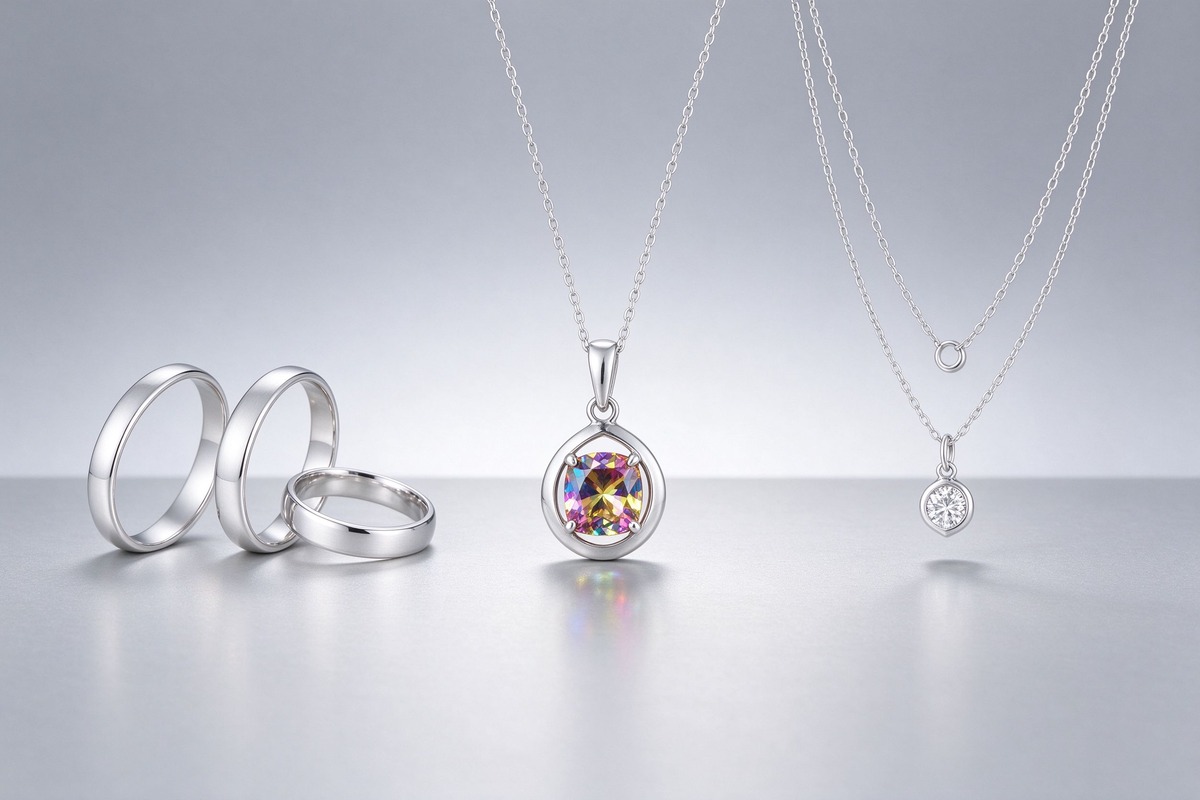
"Which style is selling best?" is the wrong first question. Minimalist, sentimental and layered jewelry do not compete for the same purchase — they occupy different roles in an assortment. One builds the base, one carries the story, one raises the average order.
Below is the evidence behind each style, what it is good at, and how a first order can be split between them.
Three Signals, Three Different Scopes
The numbers most often quoted for these styles come from different studies with different questions. They are useful individually — but they cannot be ranked against each other as if they were one leaderboard.
Minimalist: 24% of U.S. respondents preferred plain, stone-free bands — within the ring category specifically.
Sentimental: 65% of U.S. consumers actively look for jewelry designs that include a birthstone.
Layering: third-party estimates put the global layered-necklace market at roughly USD 4.2 billion in 2025 — a market-size estimate, not a consumer preference share.
Read that way, the three numbers tell you what each style is for, not which one "wins."
Minimalist: The Base Layer
Plain bands and simple studs are the least risky thing you can stock. They do not depend on a trend cycle, they photograph cleanly, and they sell to almost any age group. A 24% preference within rings is a real, repeatable base.
Strengths: low design risk, easy reorders, strong for gifting and everyday wear.
Watch-out: differentiation is weak. If your whole assortment is plain bands, you compete on price alone. Use minimal as the foundation, not the entire story.
Sentimental: The Story Seller
Birthstone and zodiac jewelry sells because it carries meaning — a birthday, a sign, a person. 65% of consumers actively seeking birthstones is one of the strongest preference signals in the category, and Etsy's own trend reporting showed zodiac jewelry searches up roughly 400%.
Strengths: high emotional attachment, strong gift conversion, natural personalization story, good margins because the meaning — not the metal weight — drives the price.
Watch-out: it multiplies SKUs. Twelve birthstones, twelve zodiac signs, multiple metals and sizes — plan the matrix before you order, or inventory will fragment.
Layering: The Basket Builder
Layering is less a product than a buying behavior: customers combine two or three pieces and spend more per order. A roughly USD 4.2 billion layered-necklace market estimate (third-party, 2025) reflects that behavior at scale.
Strengths: raises average order value without discounting, encourages repeat purchase, and turns single pieces into sets.
Watch-out: compatibility matters. Chain lengths, clasp types and pendant scales have to work together. Sell "layers" that clash and the returns erase the uplift.
The Three Styles Side by Side
| Dimension | Minimalist | Sentimental | Layering |
|---|---|---|---|
| Core signal | 24% prefer plain bands (rings) | 65% seek birthstones; zodiac searches +400% | ~USD 4.2B market estimate (third-party) |
| Purchase driver | Everyday wear, simplicity | Meaning, gifting, identity | Self-styling, sets, more per order |
| Typical forms | Plain bands, simple studs, thin chains | Birthstone pendants, zodiac charms, initial pieces | Layered necklaces, stack rings, sets |
| Inventory risk | Low | Medium — many SKUs | Medium — needs compatible sets |
| Best role | Base assortment | Hero and gift story | Order-value builder |
How to Split a First Order
If you are building a first assortment rather than betting on one look, a workable split looks like this — an illustrative allocation, not an actual customer order:
| Line | Share of budget | Why |
|---|---|---|
| Minimalist rings (925 silver) | ~30% | Safe base, reorder-friendly |
| Sentimental pendants (925 silver) | ~25% | Highest emotional pull and gift conversion |
| Layered sets (925 silver) | ~22.5% | Raises average order value |
| Copper & crystal | ~18% | Traffic, gifts, cheap design testing |
| Reserve | ~4.5% | Reorder what proves out |
Read this correctly: these percentages are an illustrative budget split — not benchmarking data and not a claim that one style outsells another. They are a starting structure you adjust after your first sell-through.
What Changes on the Production Side
The styles also behave differently in manufacturing. Minimalist silver bands are the simplest to repeat: fewer components, fewer failure points, faster QC. Sentimental pieces multiply the SKU matrix — each birthstone or sign is a separate production and inventory decision. Layered sets need coordinated lengths and clasps, so they are usually sampled as a group rather than piece by piece.
Across all three, the same thresholds apply: 925 silver from 20+ pieces per design with bulk production around 12–15 days, and copper from 100+ pieces with production typically inside 7 days. Sampling runs about 4–7 days at roughly three pieces per design, so you can approve a style before committing to volume.
That is the practical argument for splitting rather than betting: three styles, one production system, and a first order that can learn from its own sell-through.
Building a first assortment across these styles?
Tell us your style mix and target price band — we will map it to a production plan.
Send Your Inquiry