
A 90-Day First Order Timeline: From Inquiry to Reorder
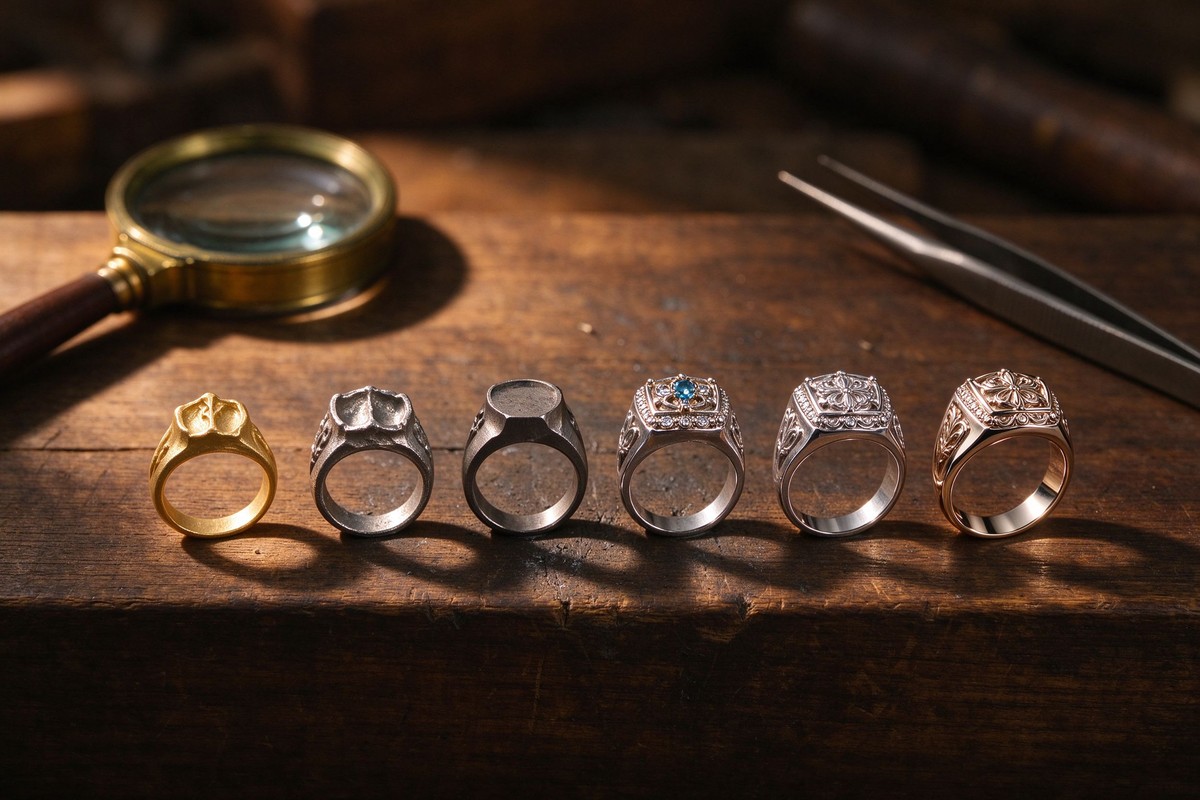
Six stages of one ring: wax, cast, filed, set, polished, finished. A first order moves through the same sequence, on a calendar.
Most first orders do not run late because the factory is slow. They run late because information arrives in the wrong order — a design without dimensions, a stone decision after the mold is cut, a packaging spec after the cartons are packed.
Here is a realistic 90-day path from first inquiry to the point where a reorder becomes obvious. The days are working days, and the ranges are the ones we quote to new buyers.
Week 1–2: Inquiry and style selection
You bring the reference: a photo, a sketch, a competitor piece, or a CAD file. What makes this stage fast is not how polished the drawing is, but whether it answers four questions — metal, stone, size, and quantity.
We come back with a quotation, a material recommendation if the design allows a cheaper construction, the MOQ for each line, and a straight answer on what is makeable and what is not. If a setting cannot hold the stone at the requested size, that is said here, not after the mold is cut.
The usual delay: a reference image with no dimensions. A ring needs an inner diameter and a band width; a pendant needs a height and a thickness; an earring needs an inner diameter and a drop length. Without those, the first sample is a guess, and the second sample is the real first sample.
Week 3–4: Sampling
Sample production runs 4–7 days, at about three pieces per design. A sample order is typically one to five pieces, paid in full upfront. Shipping is usually a courier, so add three to five days depending on the destination.
Treat the sample as a specification document, not a preview. Approve it with comments on the three things that will drift in bulk: stone tone, edge finish, and plating color. If the sample is approved with "looks good," the bulk has no standard to be measured against.
The usual delay: three rounds of small changes. Each round costs a full sample cycle, which is the single most expensive habit in a first order. Collect every change into one list before the next round starts.
Week 5–8: Bulk production
Once the sample is signed, sterling silver bulk runs 12–15 days and copper is typically completed within 7 days. The clock covers casting, filing, setting, plating and in-house QC, and it assumes the stone lot and the packaging spec are already confirmed.
Payment is 70 percent to start production and 30 percent before shipment, settled through PayPal or WorldFirst. If a mold has to be cut, the mold fee is refunded once a single design accumulates 100 pieces in silver or 500 pieces in copper — which means a first order and a first reorder usually clear it together.
The usual delay: plating color approval and packaging artwork. Both are decisions only you can make, and both sit on the critical path near the end of the run. Confirm them in week 5, not week 7.
Week 9–11: Shipping and customs
Choose the terms before the goods are packed, because they change what goes on the invoice and who clears the entry. EXW leaves the forwarder to you; DDP puts the landed cost in one number and removes the customs surprise.
The documents that travel with a jewelry shipment: commercial invoice, packing list, and — where the buyer needs them — a 925 purity report for silver and a nickel-release REACH compliance file. Batch-level records are available on request; they are not automatically enclosed, so ask at the order stage.
The usual delay: a destination requirement discovered at the port. If your market asks for a specific labeling or testing document, name it in week 1 so it can be produced alongside the goods rather than after them.
Week 12–13: Launch and the first reorder signal
Goods arrive, go on site, and the clock resets to the selling cycle. The useful question is not "did it sell" but "which size sold first." Size-level sell-through tells you what to reorder; design-level sell-through only tells you whether the style works.
A reorder usually becomes worth placing when one SKU clears sixty percent of its stock in thirty days, returns stay low, and the same design starts attracting requests for another size or another stone. At that point the second run is cheaper and faster than the first, because the mold, the stone lot and the plating recipe already exist.
| Stage | Duration | You prepare | We deliver |
|---|---|---|---|
| Inquiry | Week 1–2 | Reference, metal, size, quantity | Quote, MOQ, feasibility |
| Sample | Week 3–4 | One consolidated change list | 3 pieces, 4–7 days |
| Bulk | Week 5–8 | 70% deposit, plating and artwork approval | Silver 12–15 days, copper within 7 |
| Shipping | Week 9–11 | Terms, customs documents | Packed goods, invoice, compliance files |
| Launch | Week 12–13 | Content, size-level tracking | Reorder quote on the existing mold |
The money side, in one place
Samples are paid 100 percent upfront. Bulk is 70 percent to start and 30 percent before shipment.
Payment runs through PayPal or WorldFirst.
Mold fees return once one design reaches 100 pieces in silver or 500 in copper, counted across orders.
We run our own production workshop in Meilong, China. For export orders, we settle through our licensed trade entity — so you work directly with the makers, without a middleman in between. That is why the timeline above is short: the stages are not waiting on a trading desk to relay them.
Tell us your target launch date and we will work the schedule backwards.
Send designs, quantities and destination — you will get a dated plan, not a range.
Send Your Inquiry