
Workshop vs. Trading Company: A B2B Buyer's Guide
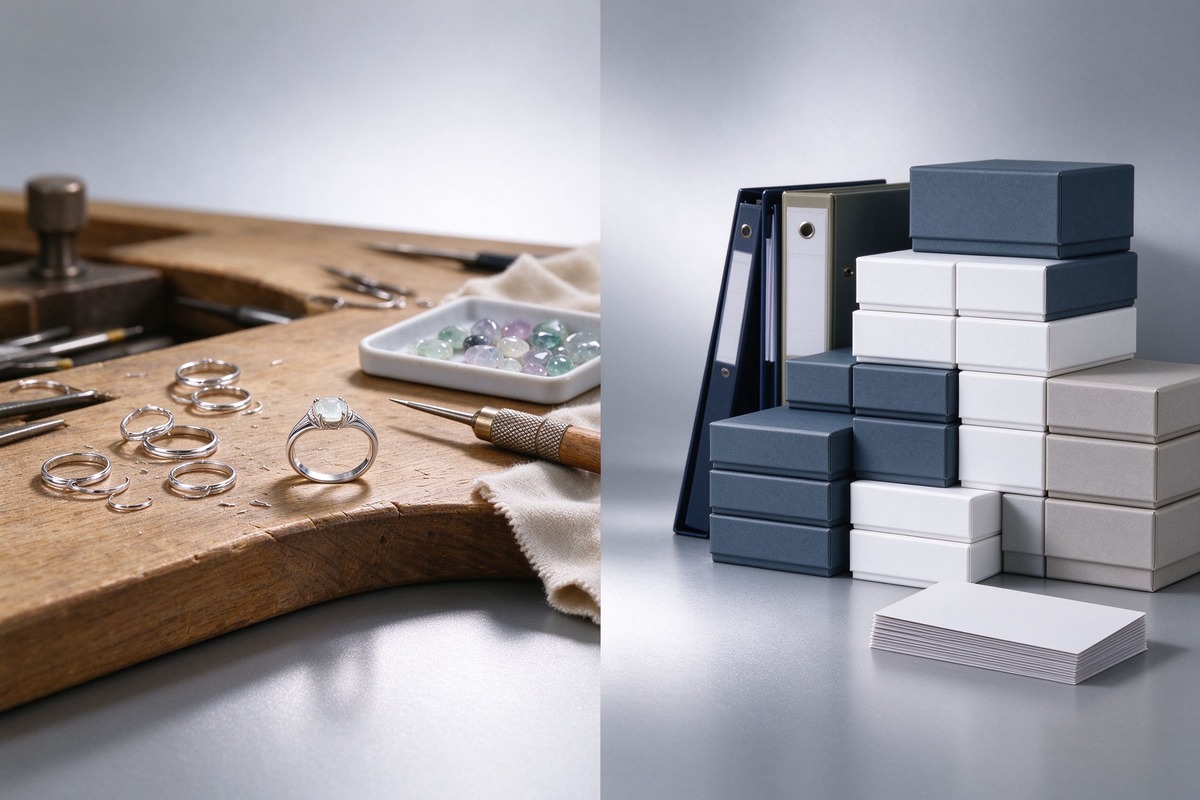
Two suppliers can quote the same ring at different prices and both be honest. One makes it; the other buys it from someone who does. That difference decides where your money goes, how fast a change happens, and who answers when a batch is wrong.
This is not an argument that one model is better. It is a guide to telling them apart — and choosing the one that fits your order.
The Two Models, Plainly
A workshop owns the production floor. It quotes labor, material and finishing from its own process, samples in-house, and controls the QC steps. Its range is narrower because it only sells what it can actually make.
A trading company owns the relationship, not the machines. It aggregates multiple factories, which gives it a wide catalog and one point of contact. Its quote includes the factory price plus its own margin, and production details sit one layer further away from you.
Neither structure is a problem by itself. Problems appear when the model you are buying does not match the job you are asking it to do.
Side by Side
| Dimension | Workshop | Trading Company |
|---|---|---|
| Price structure | Labor + material + finishing | Factory price + trading margin |
| Communication chain | Direct to the people producing | Via an account manager to the factory |
| Sampling | Made in-house; changes iterate fast | Coordinated with a third-party factory |
| Custom depth | CAD changes, molds, private label | Depends on which factory accepts the job |
| QC responsibility | The same team that made it | Split between trader and factory |
| Catalog breadth | Narrow — only what it produces | Wide — many factories, many categories |
| Best for | Repeat production, custom work, quality control | Multi-category sourcing in one order, small mixed buys |
The Hidden Cost of a Middle Layer
A trading margin is not the only cost. Every extra layer adds something else:
Time. A design change goes to the trader, then to the factory, then back — twice for every decision.
Attribution. When a batch arrives with an uneven setting, the trader and the factory can each point at the other. You hold the loss while they settle it.
Spec drift. A detail agreed verbally at the start may not survive being passed down. What you approved is not always what gets produced.
When a Trading Company Makes Sense
There are real cases where the middle layer earns its margin: you need ten categories in one shipment and do not want ten suppliers; you are testing a category you do not plan to scale; you need consolidated paperwork and logistics for a mixed container.
The rule is simple: use a trader for breadth, use a workshop for depth. Asking a trader to own your quality standard, or asking a workshop to be a one-stop shop for everything, is where orders go wrong.
How We Are Structured
"We run our own production workshop in Meilong, China. For export orders, we settle through our licensed trade entity— so you work directly with the makers, without a middleman in between."
In practice that means the people quoting your order are the people who can walk to the bench and change it. Sampling runs 4–7 days at roughly three pieces per design; 925 silver bulk production is typically 12–15 days at 20+ pieces per design; copper runs 100+ pieces with production usually inside 7 days. Batch-level 925 purity reports and nickel-free REACH documents are available, and every shipment is documented with photos or video before dispatch.
We are narrower than a trader by design. What we sell, we make.
Five Questions That Reveal the Model
1. Can I see the workshop? A live video walk-through, not a photo library.
2. Who physically makes the sample? The answer should name a team, not a partner.
3. What is inside the quote? Ask for the cost breakdown: material, labor, plating, packaging.
4. Who owns a defect? Get the answer in writing before the order, not after.
5. Who owns the mold? Custom molds and CAD files should have a stated owner and a stated reuse rule.
A supplier who answers all five without hesitation is telling you what it is. A supplier who deflects is telling you something too.
Want to see the workshop before you order?
Ask for a live walk-through and a quote with the cost breakdown — we will send both.
Send Your Inquiry